Hearing
Tests

Doctor Checking the Blood Pressure of Her Patient

Pure Tone Audiometry

Looking for a Hearing Test In Maidstone, Sevenoaks and Kent? Pure Tone Audiometry is the most commonly used type of a hearing test, which establishes the quietest levels of sound that the person can hear across different frequencies (pitches). It is a fairly quick and non-invasive test.  Patients are instructed to respond to the sounds that they hear through a pair of head/earphones, usually by pressing a response button.  For accuracy, the test is performed in a sound-proof booth.  The results are useful for investigation of the level, type and possible cause of the hearing loss and, along with other tests, for initial programming of hearing aids.  The whole consultation, including full history taking and testing last approximately 30 minutes.  Suitable for adults and children over 5 years of age.
Energetic woman smiling after workout

Speech Audiometry

Speech Audiometry is often used to confirm the hearing threshold levels attained during the Pure Tone Audiometry, and gives useful information on person’s speech understanding and intelligibility. Patients are asked to repeat words that are being played to them at various levels through the head/earphones, until they can no longer clearly hear or distinguish the words. The threshold is then recorded and results are used in hearing therapy, identification of certain types of hearing loss and in hearing aids programming.
Tympanometry and Acoustic Reflexes all ears Maidstone and Sevenoaks

Tympanometry and Acoustic Reflexes

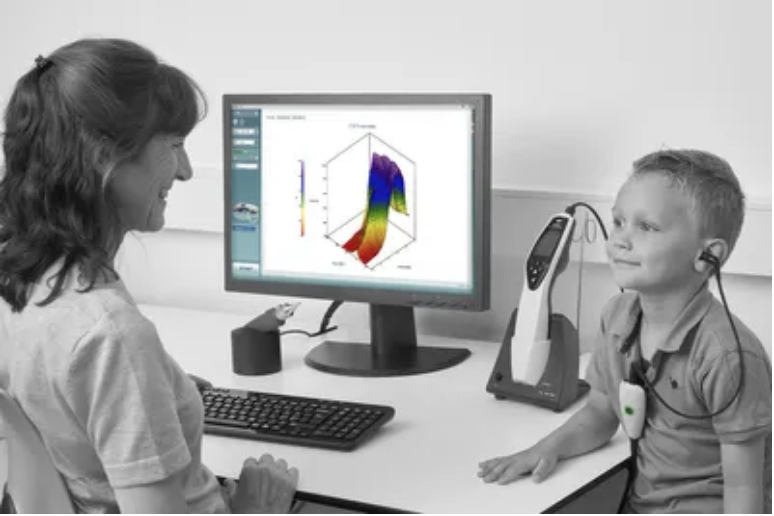
These tests usually accompany Audiometry and further assess the function and integrity of the middle ear – that’s the eardrum, the three little bones (incus, malleus and stapes) that attach to the other side of the eardrum and conduct sound, and the space within which they are situated.  They are most commonly used to check for presence of fluid behind the eardrum (“glue ear“), holes in the eardrum, Eustachian Tube dysfunction and other peripheral and central ear disorders.  They are non-invasive and comfortable tests that involve gentle pressure being applied to the eardrum for a few seconds, followed by a series of brief loud sounds.  They are suitable for patients of all ages.
Otoacoustic emissions all ears

Otoacoustic Emissions

Otoacoustic Emission is a sound generated by the cochlea – the “snail-like” hearing organ in the inner ear. It is normally used to determine the function of the cochlea and can be used to complement the Pure Tone Audiometry and Tympanometry tests. Because the tests is purely objective, it is often used in our paediatric assessment, on children that are too young to undergo Pure Tone Audiometry. In fact, Tympanometry and Otoacoustic Emissions tests form part of our paediatric assessment package, which is very popular and effective. Although we cannot establish the level of hearing, we can predict it by checking the health of the middle and inner ears.
Tinitus match test all ears Maidstone and Sevenoaks

Tinnitus Match

The Tinnitus Match test is used to subjectively evaluate the loudness and pitch of the tinnitus perceived by the patient, as well as predict the success of the tinnitus management therapies (e.g. sound therapy, hearing aids).  The patient is first presented with a series of tones, and then has to decided which one was closest to the perceived tinnitus sound.  It is a highly subjective test, as all depends on patient’s perception and ability to differentiate different sound pitches.  It takes approximately 30 minutes, and the results are used in creating an Individual Management Plan for tinnitus rehabilitation.